Taj Mahal Quartzite: Is It Worth the Hype?
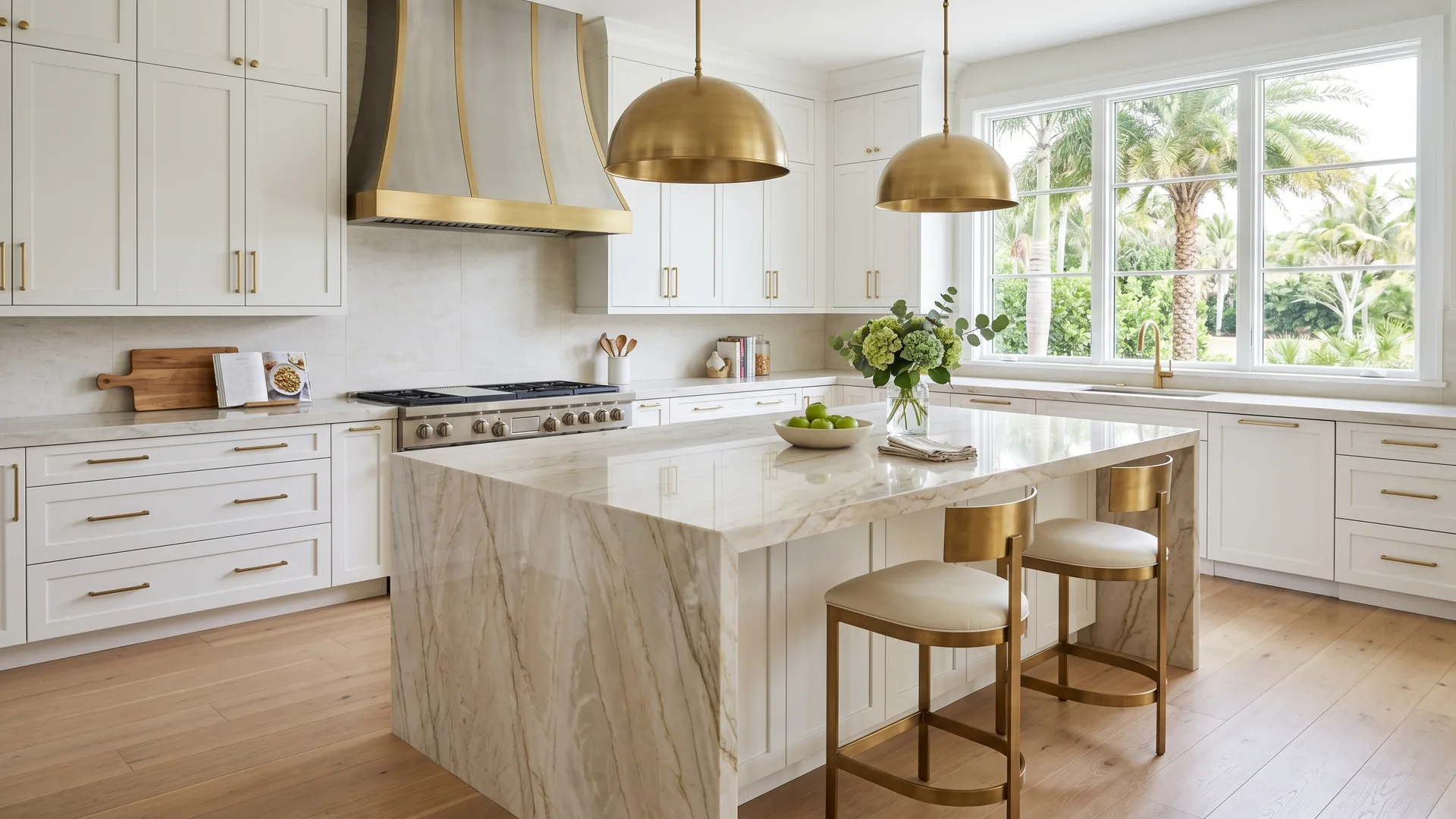
Taj Mahal is the most-requested stone at the JR Stone Design showroom right now. Not quartz. Not calacatta. Not granite. Taj Mahal. JR Stone has installed dozens of Taj Mahal kitchens across Palm Beach County over the past few years, and the appeal is obvious. The stone photographs beautifully, it handles Florida's humidity and salt air better than marble, and the soft beige palette fits the coastal-modern look almost every client is chasing.
But Taj Mahal is not the right pick for every kitchen. Here's what JR Stone Design tells clients who come in asking for it.
What Taj Mahal actually is (and isn't)
Taj Mahal is a natural quartzite quarried in Brazil. Not marble, which trips up almost every client who first sees it. The confusion is understandable: the palette is similar — soft beige, warm cream, flowing gold and grey veining — and a lot of Instagram shots make them look identical. But they're different stones with different behavior.
Quartzite is mostly quartz crystal, which scores 7 on the Mohs hardness scale. Marble is calcium carbonate, scoring around 3. That sounds nerdy until a glass of lemonade gets spilled on both. Marble etches a dull spot within minutes. Taj Mahal wipes clean. For Florida kitchens where citrus, tomato, and vinegar get used daily, that difference matters.
Where Taj Mahal sits in the broader family: it's one of several Brazilian quartzites that hit the US market around 2018 and exploded after 2020. Mont Blanc, Macaubas White, Perla Venata, and a half-dozen others are cousins. They come from quarries in the Minas Gerais region and share the same rough chemistry with different color variations.
Why every client asks for it right now
Three reasons, stacked:
It looks like marble without acting like marble. Designers figured this out first. Calacatta marble had been spec'd on high-end kitchens for decades, with maintenance complaints baked into the deal, and Taj Mahal solved the problem. The soft veined look stayed, the etching went away. Instagram did the rest.
It works with the current aesthetic. White shaker cabinets, brass hardware, warm wood floors, palm trees outside the window. Taj Mahal fits that exact picture. Carrara marble used to fill that slot, but Carrara runs colder — more grey than beige. Taj Mahal's warmth works harder for Florida light.
Every slab is unique. Natural quartzite means no two pieces match. Clients who want their kitchen to look "like theirs" and not like a catalog spec gravitate to it. The JR Stone team helps each client choose Taj Mahal from samples at our Riviera Beach showroom and walks you through the natural variation to expect before we template and cut your counter.
The tradeoffs nobody on Instagram mentions
Between the bridge saw and the install crew, the JR Stone shop has pulled a lot of Taj Mahal slabs over the years. A few honest observations.
Slab-to-slab variation is real
Because natural quartzite varies batch to batch, a sample is a guide to the color and character, not an exact map of your slab. The overall look is consistent (beige background, gold veining), but the vein density, the color temperature, the grey content — all of that shifts from lot to lot. We go over this with you when you choose Taj Mahal from samples at our Riviera Beach showroom, so there are no surprises on install day.
Vein matching requires planning
For the veining to flow continuously across the counter and up a full-height backsplash, there needs to be enough slab to cut from. On a 50+ sq ft kitchen with backsplash, that's two slabs minimum. The JR Stone fab shop bookmarks them before cutting so the veining mirrors across the seam. It's more labor at the fab stage — all of it done in the Riviera Beach shop — but it's the difference between a $10K counter and a $14K one that looks like museum-grade stone.
It needs sealing
Annual at minimum. Twice a year for heavy-use kitchens. Unsealed quartzite will eventually absorb a red-wine spot or a bacon-grease ring. Sealed, it shrugs off both. Every stone JR Stone installs gets sealed before the crew leaves the job, and clients get a care sheet with the seal date and product.
Exotic grades hit exotic prices
The "entry" Taj Mahal at $85/sf installed is one stone. The premium-grade slab from a small Brazilian quarry with dramatic vein concentration is a completely different stone at $175+/sf installed. Clients sometimes assume all Taj Mahal is the same. It's not.
What it actually costs installed
Palm Beach County pricing at JR Stone Design as of April 2026. (To budget the project before requesting a quote, see our guide on how to measure kitchen countertops for a quote so you have an accurate square-foot count to apply these rates to.)
- Standard-grade Taj Mahal: $85 to $115 per installed square foot
- Premium-grade: $120 to $175 per installed square foot
- Exotic / bookmatched slabs: $180 to $225+ per installed square foot
A typical 50 sq ft kitchen runs $4,250 to $8,750 for standard-grade, $6,000 to $8,750 for premium. Add a waterfall island ($300 to $800 per side), a vein-matched backsplash ($50 to $150 per square foot of wall), and a mitered edge ($25 to $50 per linear foot), and a fully decked-out Taj Mahal kitchen with all the upgrades lands in the $12,000 to $20,000 range before cabinetry.
For context, granite runs $50 to $90/sf installed. Quartz runs $65 to $120. Taj Mahal sits at the top of the mid-range natural stone bracket, comfortably below Calacatta marble ($150 to $300+) but above most granite and mid-tier quartz.
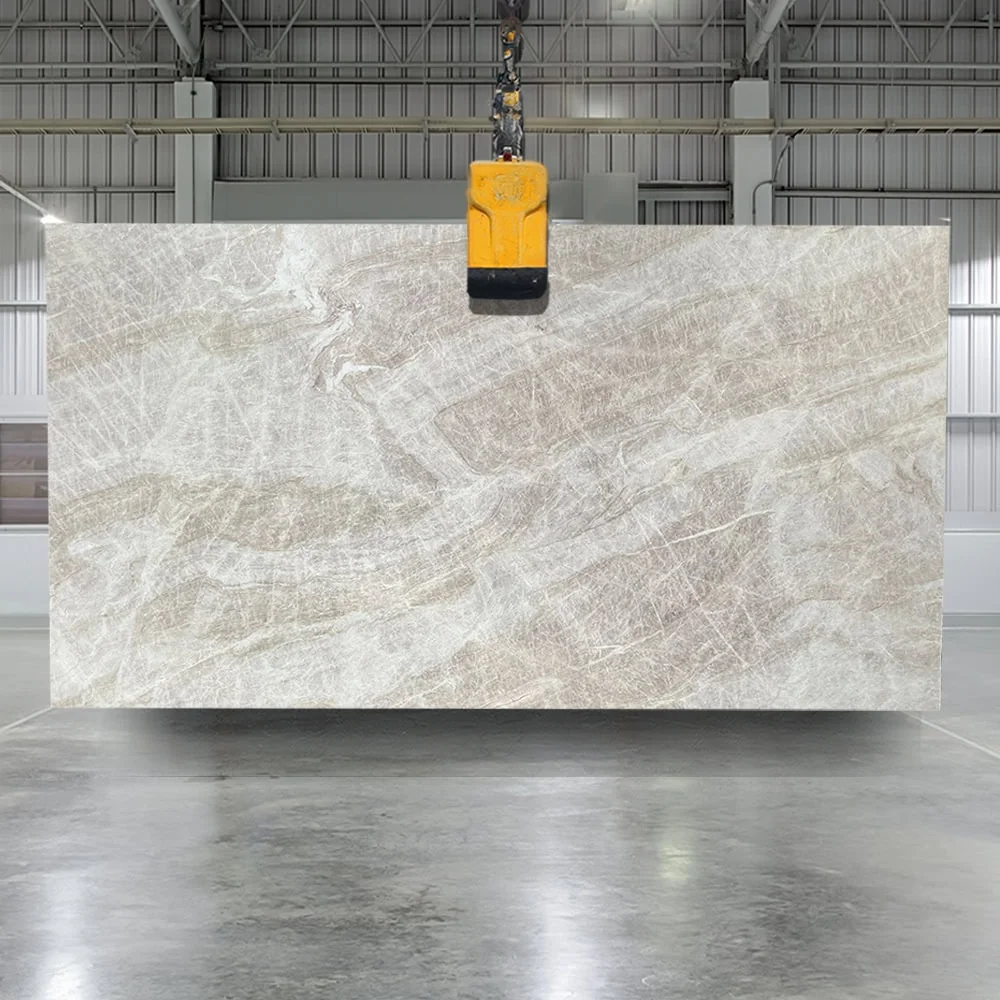
Leathered Taj Mahal: softer matte finish with subtle tactile texture. The leathered treatment tones down the veining and hides fingerprints far better than a polished surface.
Polished vs leathered: two finishes, very different kitchens
Full breakdown: Honed vs leathered vs polished countertops, compared →
Most Taj Mahal installed in Palm Beach County is polished — the high-gloss finish that reflects light and shows the veining most dramatically. But the same stone is available in a leathered finish, and once installed, the two finishes read as genuinely different materials.
Polished
High-gloss mirror finish. Traditional showroom look. Reveals the maximum depth and translucency of the stone. What most of the Pinterest kitchens use. Best suited for kitchens leaning modern, luxury, or formal.
Leathered
Subtle textured finish with a slight pebbled surface. Reads matte from a few feet away, with a soft tactile quality up close. Hides fingerprints, water spots, and minor scratches far better than polish. Tones down the veining so the stone feels calmer and less dramatic. Best suited for kitchens leaning organic, farmhouse, transitional, or coastal-casual.
Practical differences
- Fingerprints: Polished shows every smudge. Leathered hides them.
- Cleaning: Both wipe clean. Leathered needs slightly more care in the pebbled texture during deep cleans.
- Sealing: Same schedule — annual for both.
- Pricing: Leathered typically adds $5 to $15 per square foot installed because the finishing process takes more time.
- Slab availability: Polished is stocked in depth at most yards. Leathered sometimes requires a special order through the quarry, adding 2 to 3 weeks to lead time.
Which finish to pick
For high-traffic kitchens with kids or frequent entertaining, leathered hides the daily wear that shows on polished. For formal or high-gloss aesthetics, polished delivers more visual impact. Both are correct answers for Taj Mahal — the right pick depends on how the kitchen actually gets used.
Three alternatives worth comparing
When Taj Mahal stretches the budget, or when the natural-stone maintenance is a dealbreaker, three stones come up regularly on the JR Stone showroom floor. An honest walkthrough of each:
1. Mont Blanc Quartzite
The closest natural cousin. Also Brazilian, same quarry region, similar hardness and performance. The difference is color: Mont Blanc runs cooler — whiter background, more pronounced blue-grey veining instead of Taj Mahal's gold. For clients who want the quartzite durability but prefer a crisp-white kitchen over a warm-beige one, Mont Blanc is the pick.
Installed pricing: $70 to $140/sf. Runs roughly 15% cheaper than Taj Mahal at the standard grade. Needs the same annual sealing.
2. Cambria Brittanicca (engineered quartz)
For the veined look with zero maintenance, Brittanicca is the most convincing quartz imitation JR Stone installs. Cambria prints the veining pattern into the quartz slab during manufacturing, which means every slab matches the sample. No surprises at the yard, no sealing ever, no etching ever.
The tradeoff: printed veining doesn't have the visual depth of a real natural stone. Up close it reads as a pattern, not as geology. Most clients don't mind. Some notice immediately and ask for the real thing.
Installed pricing: $75 to $130/sf.
3. MSI Q Calacatta Laza (engineered quartz)
Calacatta Laza is a different aesthetic entirely — whiter background, heavier grey veining, more of a dramatic marble look than a warm-beige one. The stone is worth mentioning because clients frequently come in asking for Taj Mahal when what they actually want is the marble look. For the high-contrast white-and-grey kitchens all over Pinterest, Calacatta Laza nails that look for less money with zero maintenance.
Installed pricing: $80 to $135/sf.
How to decide if it's right for your kitchen
A few questions the JR Stone team asks clients who come in set on Taj Mahal:
- Is annual sealing realistic? If the honest answer is "I'll forget," natural quartzite is the wrong choice. Quartz is the better pick.
- How much does the actual stone pattern matter? For an exact match to a Cambria sample, skip natural quartzite entirely. Real stone varies.
- How much does it vary? Taj Mahal shifts noticeably from lot to lot, so treat a sample as a guide to the look and feel, not an exact match for your slab. We walk every client through the expected variation when you choose from samples at our Riviera Beach showroom, so install day matches what you pictured.
- What's the actual countertop budget? When Taj Mahal pushes over it, Mont Blanc delivers 90% of the look for 85% of the cost.
- Indoor, outdoor, or both? For outdoor kitchens, natural quartzite is one of the few stones that holds up in direct sun and salt air. Quartz yellows outdoors. Marble erodes. For mixed indoor-outdoor projects, Taj Mahal is actually the right answer even at the higher price.
Clients who work through these questions typically end up in one of three camps: they commit to Taj Mahal with eyes open, they swap to Mont Blanc to save budget, or they pivot to Brittanicca because the maintenance question tips the decision. All three are defensible choices. The worst outcome is picking Taj Mahal because it looks pretty on Instagram and then being surprised by the sealing, the slab variation, or the bill.
For homeowners in Palm Beach County weighing Taj Mahal for a kitchen project, the JR Stone Design showroom has samples of all four stones on the material board. Book a free consultation to see what each one looks like under real light, not just phone-camera light.
Common questions
Is Taj Mahal quartzite actually marble?
No. Taj Mahal is a natural quartzite quarried in Brazil. It gets confused with marble because the palette (soft beige, warm cream, flowing veins) reads similar. But quartzite is mostly quartz, scoring 7 on the Mohs hardness scale. Marble is mostly calcium carbonate, scoring around 3. The practical difference: Taj Mahal resists etching from acids like lemon juice and vinegar. Marble does not.
How much does Taj Mahal quartzite cost installed in Palm Beach County?
Installed pricing runs $85 to $175 per square foot at JR Stone Design. Premium or exotic-grade slabs can push to $200+ per square foot. A typical 50 square foot kitchen runs $4,250 to $8,750 for Taj Mahal alone. Edge profile, waterfall ends, and whether you vein-match the backsplash all affect final pricing.
Does Taj Mahal quartzite need to be sealed?
Yes. Seal on delivery, then every 12 months for most kitchens. In heavy-use kitchens (lots of cooking, kids, frequent wine pours) push to every 8 to 10 months. The install crew hands clients a care sheet with the seal date and product used.
Will Taj Mahal stain?
If it's properly sealed, no. Red wine, coffee, tomato sauce, and olive oil all wipe off a sealed surface without leaving a mark. The stain risk only appears when sealer has worn off and a liquid sits on the stone for hours. Annual sealing prevents this.
Is Taj Mahal quartzite harder than granite?
Yes, slightly. Quartzite typically scores 7 on the Mohs hardness scale. Granite scores 6 to 7 depending on the mineral composition. In practice, both are plenty hard for countertop use. Neither scratches from normal cooking knives or dropped utensils.
Can I use Taj Mahal quartzite outdoors in Florida?
Yes. Quartzite handles Florida humidity, salt air, and UV better than marble or quartz. Quartz yellows under sustained sun. Marble erodes in salt air. Natural quartzite is one of the few polished stones that holds up long-term for outdoor kitchens. Just keep sealing it annually.
What's the difference between Taj Mahal, Calacatta, and Mont Blanc?
Taj Mahal is a beige-cream Brazilian quartzite with soft gold and grey veining. Mont Blanc is a cooler-white quartzite with pronounced blue-grey veining. Calacatta is a type of marble (or a marble-look quartz pattern), not a quartzite, and has a whiter background with grey veining. All three overlap visually but only Taj Mahal and Mont Blanc are natural quartzites. Calacatta marble etches; Calacatta quartz does not.
What is leathered Taj Mahal quartzite?
Leathered Taj Mahal is the same stone as polished Taj Mahal but finished with a subtle textured surface instead of a high-gloss mirror finish. The leathered treatment creates a slightly pebbled, matte-looking surface that hides fingerprints, water spots, and minor scratches far better than polish. It also tones down the veining so the stone reads calmer. Leathered typically costs $5 to $15 more per square foot than polished and sometimes requires a special quarry order, adding 2 to 3 weeks of lead time.