Full Backsplash vs 4-Inch Backsplash: Which One Fits Your Kitchen
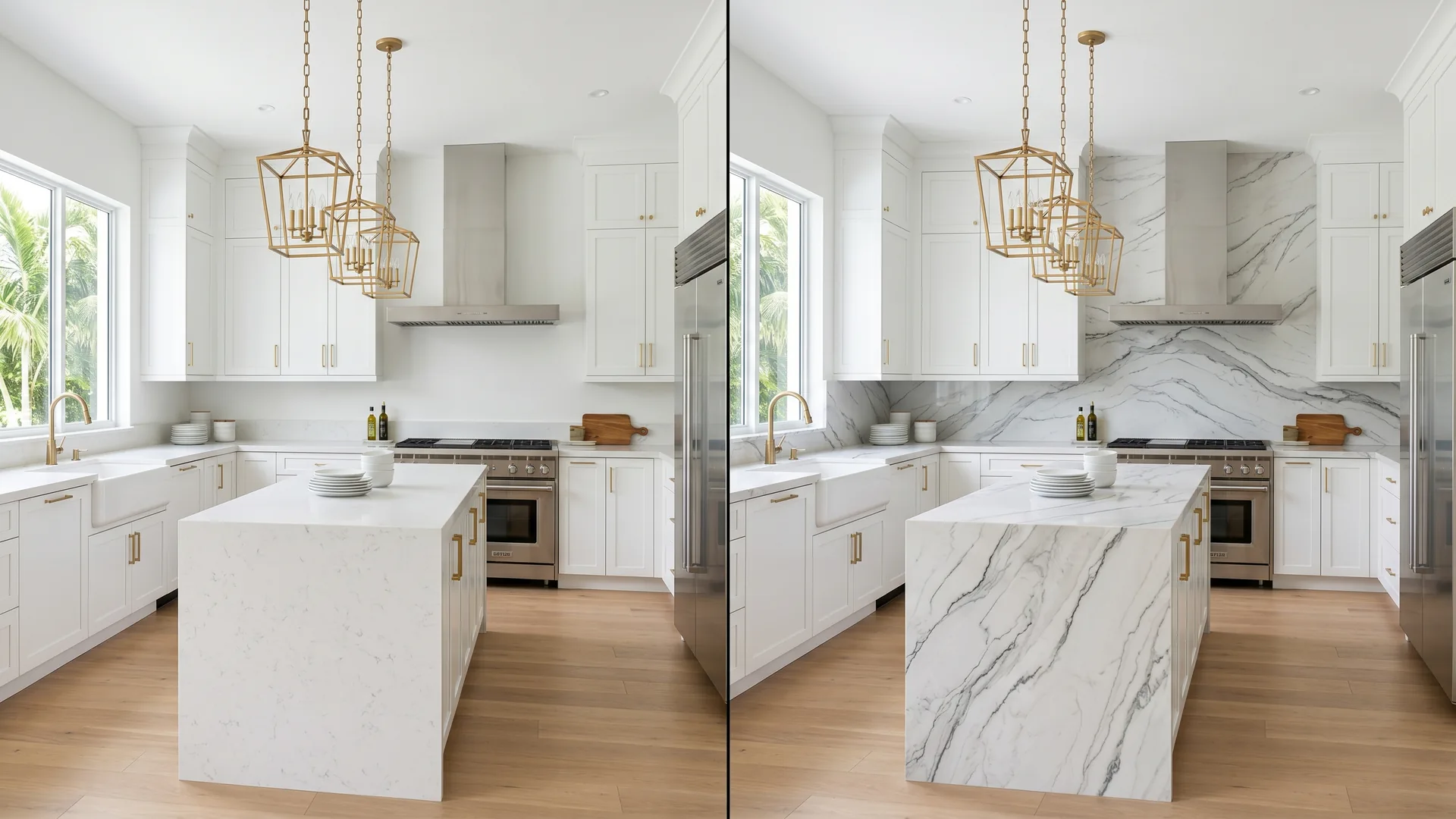
This is one of the most common questions we get during templating. Cabinets are in, the counter is being measured, and somewhere in there the homeowner has to commit: short backsplash or full?
It's not a huge decision. Both look good when done right. But the cost gap is real, the right choice depends on your stone, and once the slab is cut you can't undo it. Here's how to think it through.
What Each One Actually Is
A 4-inch backsplash is a short strip of countertop stone that runs along the wall above your counter. It's typically 4 inches tall, cut from the same slab as the counter itself, and installed at the same time. It protects the wall from splashes and water damage at the counter line. Above it, the wall is just paint or whatever finish you already have.
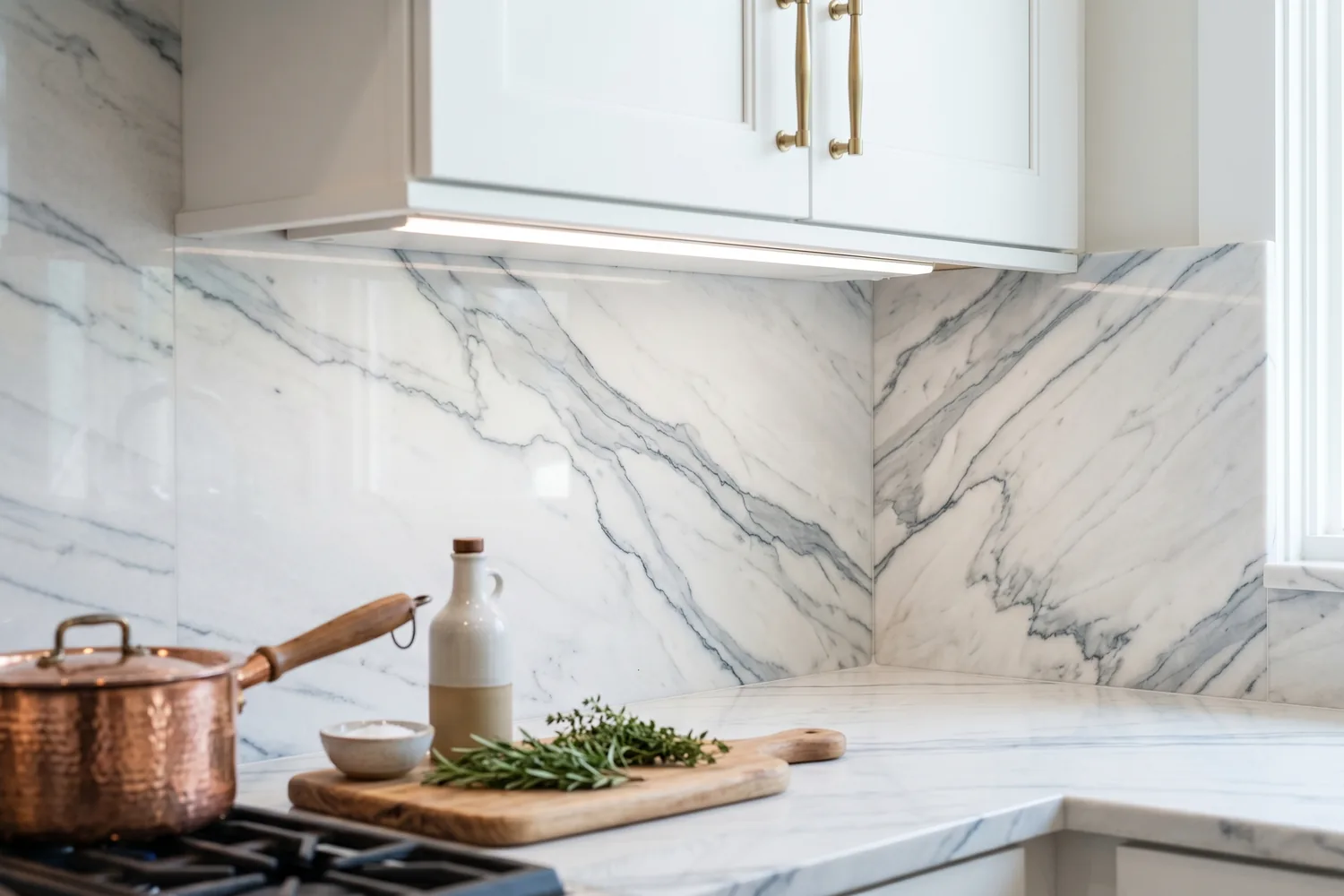
A full-height backsplash runs from the countertop up to the underside of your upper cabinets — usually around 18 inches. It can be the same stone as your counter (the look most people picture when they think "full backsplash"), or it can be a separate material: tile, glass, brick, a different stone. The point is that the entire wall section between counter and uppers is covered.
The 4-inch is cheap, easy, and conservative. The full-height is the dramatic move. Which one you want depends on your stone, your kitchen, and how much you're willing to spend on the wall section that nobody sits at.
The Cost Difference
This usually decides it for half our clients before they even look at the visuals.
| Option | What it adds |
|---|---|
| 4-inch stone strip | Often included; adds $5–$10 per linear foot if billed separately |
| Full-height stone (same slab) | $50–$150 per square foot — figure $1,500–$4,500 for a typical kitchen |
| Full-height tile backsplash | $15–$60 per square foot installed — $450–$1,800 typical |
| Vein-matched bookmatched stone | Top of the range — can hit $200+ per sf because of slab yield loss |
The 4-inch usually slides into your countertop quote because we cut it from leftover slab. Full-height stone is its own line item because we have to source enough additional slab to cover the whole wall section — sometimes that means buying a second slab if your kitchen is large or your stone is rare.
If you want full-height but not in stone, tile gets the look-cost ratio dramatically friendlier. A nice tile backsplash from a local supplier runs $20–$40 per square foot installed. That's the middle path most kitchens end up taking.
When the 4-Inch Wins
Pick the 4-inch if any of these are true:
- Your stone is uniform. Most quartz patterns, basic granite, soapstone — the visual reward of running it up the wall is small because there's nothing dramatic to show off.
- You want tile later. The 4-inch is the right placeholder if you're not sure what backsplash you want. It looks finished, it protects the wall, and you can add tile above it any time. Lots of kitchens live with just a 4-inch for years and never add tile.
- You have an open shelf or window above the counter. If there's no wall to fill, a full backsplash has nothing to do. The 4-inch handles the splash protection at the counter line, which is all you need.
- Budget matters more than the visual. The full-height stone treatment is genuinely expensive, and it's the easiest place to cut without compromising the function of the kitchen.
The 4-inch isn't a downgrade. It's the standard for a reason — it does the practical job of a backsplash without spending money on a feature that doesn't matter for every kitchen.
When the Full Backsplash Wins
Pick the full-height if any of these are true:
- You bought a high-character slab. Calacatta marble, Mont Blanc quartzite, exotic granite — you paid for the veining, so show it. A 4-inch strip cuts off the visual at the counter line, which is exactly the wrong move for a stone you chose because of how it looks.
- You hate cleaning grout. A full stone backsplash has zero grout lines. Splashed marinara wipes off in two seconds. Tile is fine, but it has joints, and joints accumulate stuff over the years.
- The kitchen is the visual centerpiece of the home. Open-concept floor plan, kitchen visible from the dining and living areas. Full-height stone reads as a continuous high-end finish from across the room. A 4-inch + paint reads as a nice but ordinary kitchen.
- You want to skip tile entirely. Tile installation is a separate trade and a separate appointment. Full-height stone is done by the same crew that does the counter, on the same day. One contractor, one invoice, one warranty.
The Vein-Matching Question
This is where full-height stone earns its premium — or doesn't.
A "vein-matched" or "bookmatched" backsplash is when the stone on the wall picks up the veining from the counter at the seam, so the lines flow continuously from horizontal to vertical. Done well, it looks like a single piece of stone wrapping the corner. Done poorly, the seam is obvious and the veins go in different directions.
To do it right, the fabricator has to:
- Cut the counter and backsplash from adjacent sections of the same slab so the vein patterns line up.
- Plan the cuts before cutting either piece — once the counter is cut, the backsplash piece is locked in.
- Polish the seam edges so the joint between counter and backsplash disappears.
This is shop work, not installation work. We do it in our Riviera Beach fabrication shop, where we can lay out the whole slab and plan the cuts together. Outsourced fabricators sometimes skip this planning step and the result shows up at your install with mismatched veining you can't unsee.
How to Decide in 5 Minutes
Three quick questions get you to the right answer for almost every kitchen:
1. Does your stone have dramatic veining?
- Yes → lean full-height to show it off
- No → lean 4-inch and put your money elsewhere
2. Is the kitchen visible from the living/dining area?
- Yes → full-height earns its cost as a focal point
- No → 4-inch is plenty
3. What's your overall countertop budget?
- Standard quartz/granite kitchen ($3,000–$8,000 in stone) → 4-inch fits the budget proportionally
- Premium quartzite/marble kitchen ($8,000+ in stone) → full-height is consistent with the rest of the spend
If you're still on the fence after those three, the tiebreaker is usually the slab itself. We bring a sample of your chosen stone to the templating appointment, hold it against the wall, and you can see the difference in five seconds. Most homeowners decide right there.
One last thing: if you really can't decide, the 4-inch is the safe move because you can add tile later. The full-height is harder to undo — you'd have to demo the stone backsplash to put something else up.
Want a Quote With Backsplash Options Priced In?
We'll quote both 4-inch and full-height options so you can see the cost difference for your kitchen before you commit.
Se habla español
We respond within one business day · No spam, no obligation
Related: Want to see how the slab actually gets cut? Tour our fabrication shop →
Frequently Asked Questions
What is a 4-inch backsplash?
A 4-inch backsplash is a short strip of countertop material that runs along the wall above the counter, typically 4 inches tall. It's cut from the same slab as the countertop, fabricated and installed at the same time, and protects the wall from water and food splash without changing the look of the rest of the wall.
What is a full-height backsplash?
A full-height backsplash runs from the countertop up to the underside of the upper cabinets — typically 18 inches tall. It can be the same stone as the counter (giving a continuous look) or a separate material like tile, glass, or a different stone. Full-height covers the entire wall section between counters and uppers.
How much does a full backsplash cost vs a 4-inch?
A 4-inch stone backsplash is usually included or adds $5 to $10 per linear foot to the countertop quote because it uses leftover slab material. A full-height stone backsplash adds $50 to $150 per square foot, depending on stone choice and whether it's vein-matched. For a typical 30 square foot wall section, that's roughly $1,500 to $4,500 added to the project.
Should I get a full backsplash if I have dramatic veined stone?
Yes, almost always. The whole point of buying a dramatically veined slab — calacatta marble, Mont Blanc quartzite, exotic granite — is to show off the veining. A 4-inch strip cuts off the visual effect at the counter line. A full-height backsplash lets the veining flow continuously up the wall and is the right choice when you've already invested in a high-character slab.
Can a 4-inch backsplash be vein-matched?
Yes, the 4-inch piece is normally cut from the same slab as the counter, so the veining picks up where the counter ends. It's a subtle effect because the strip is short, but on dramatic stone it still reads as a continuous piece. Ask your fabricator to bookmark the cut so the vein flow is preserved.
Is a tile backsplash better or worse than a full stone backsplash?
Different, not better or worse. Tile is cheaper, gives you texture and color contrast, and is what most kitchens have used for decades. A full stone backsplash is more expensive but has zero grout lines, is easier to clean, and gives a continuous high-end look. Tile suits casual and traditional kitchens; full stone suits modern and luxury.
Do I have to commit to either at the time of countertop install?
For a 4-inch stone backsplash, yes — it has to be cut from the same slab as the counter, so the decision happens at templating. For tile or a separate full backsplash, no — those can be installed days, weeks, or even months later. Many homeowners install just the counter first, then add tile after they've lived with the kitchen for a while.