Quartz vs. Quartzite vs. Marble vs. Granite: Pros and Cons
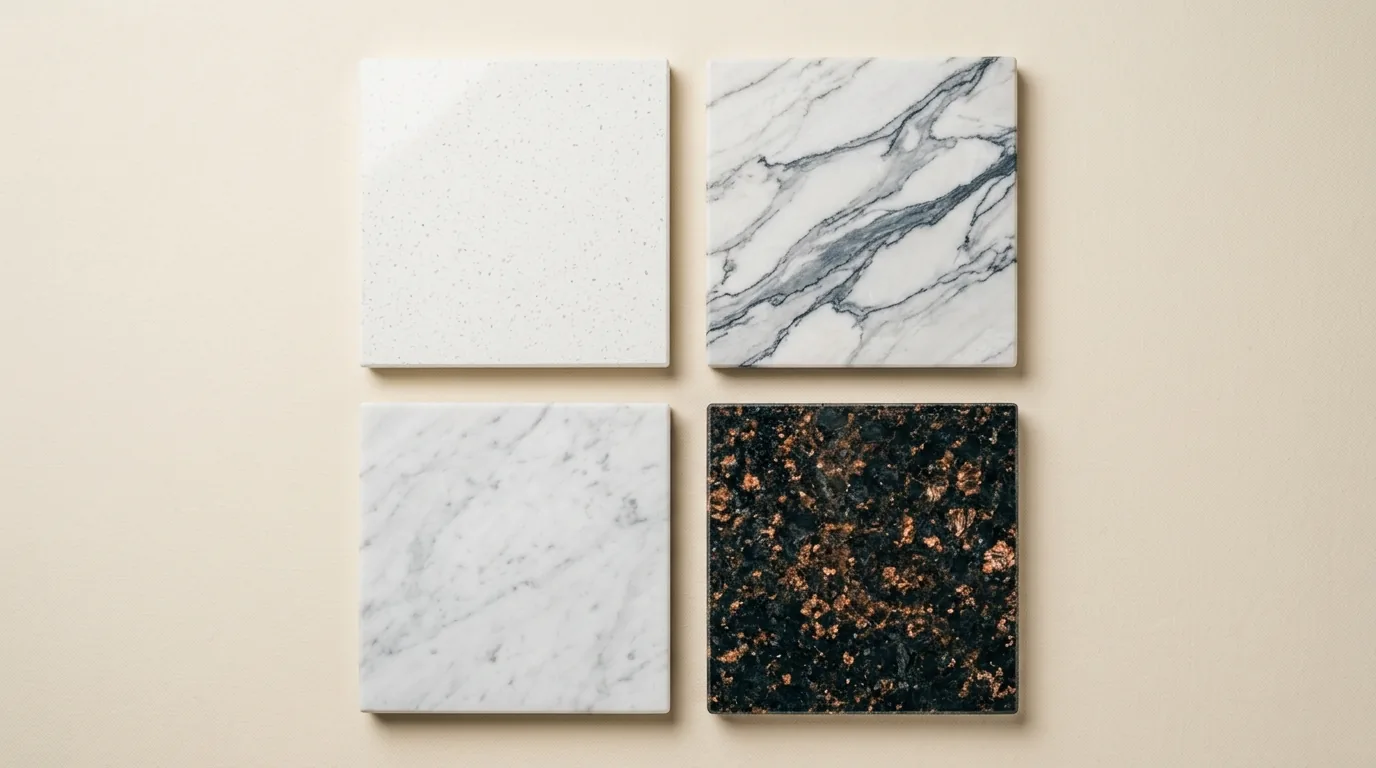
If you’ve started shopping for countertops you’ve already noticed the choices feel circular. Every salesperson has a favorite, every blog post has a different ranking, and the names — quartz vs. quartzite especially — sound like the same thing. They’re not.
We install all four materials in Palm Beach County kitchens every week. Here’s the honest comparison, including what each one actually costs and which one fits which kind of kitchen.
At-a-Glance Comparison Table
| Quartz | Quartzite | Granite | Marble | |
|---|---|---|---|---|
| Type | Engineered | Natural stone | Natural stone | Natural stone |
| Installed cost (PBC) | $65–$120/sf | $85–$175/sf | $50–$90/sf | $75–$150/sf |
| Sealing needed | Never | Annually | Every 1–2 years | Every 6 months |
| Heat resistance | Good | Excellent | Excellent | Good |
| Stain resistance | Excellent | Good (sealed) | Good (sealed) | Poor |
| Etches from acid | No | Rarely | No | Yes |
| Hardness (Mohs) | 7 | 7+ | 6–7 | 3–5 |
| Look | Uniform/patterned | Dramatic veining | Speckled/varied | Soft veining |
Quartz: The Workhorse
Quartz is engineered stone — about 90% ground natural quartz crystals bound with resin and pigment, formed into slabs at a factory. Brand names you’ll recognize: Cambria, Caesarstone, Silestone, MSI Q.
Pros
- Zero maintenance. Non-porous, never needs sealing, no special cleaners. Soap and water for life.
- Stain-proof. Wine, oil, coffee, juice — all wipe off. The resin binder keeps liquids from penetrating.
- Consistent appearance. Manufactured in controlled batches, so what you see in the showroom is exactly what shows up in your kitchen. No slab-to-slab surprises.
- Wide price range. Entry-level quartz starts around $65/sf installed. Premium designer lines like Cambria’s Brittanicca run up to $120/sf.
Cons
- UV sensitivity. Direct sun through south or west-facing windows can yellow some quartz over years. We steer clients toward quartzite or porcelain for sun-blasted kitchens.
- Heat limit around 300°F. Don’t put a screaming-hot pan straight from the stove on quartz — the resin can scorch or discolor. Trivets are mandatory.
- Engineered look. Even premium quartz patterns look slightly “perfect.” If you want unique character, natural stone reads more authentic.
Quartzite: The Cook’s Stone
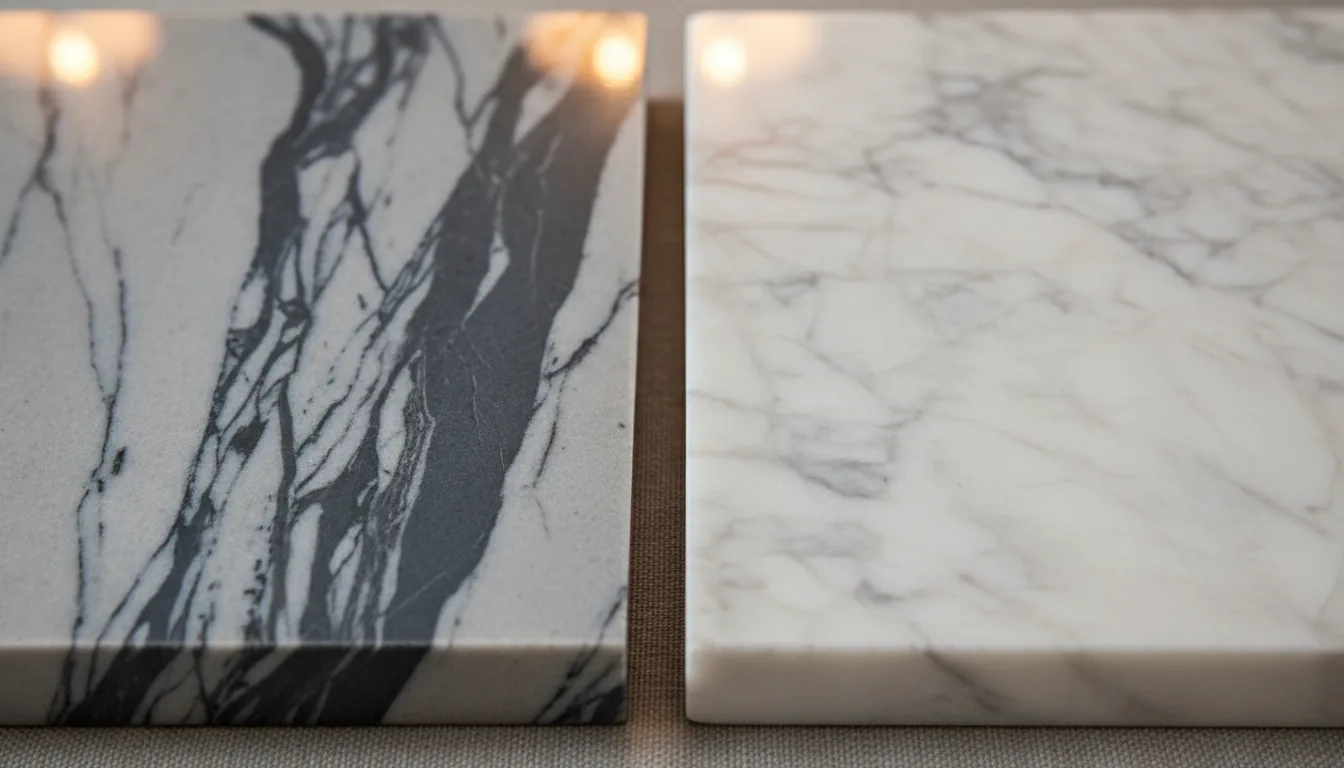
Quartzite is natural stone — metamorphic rock formed from sandstone under heat and pressure. It’s harder than granite, has unique veining patterns nobody can replicate, and handles real cooking heat better than quartz. Popular slabs: Mont Blanc, Taj Mahal, Fantasy Brown, Macaubas.
Pros
- Hardest of the four. Mohs hardness 7+, harder than steel. Won’t scratch from kitchen knives.
- Heat-resistant. Set a hot pan on quartzite without a trivet (we still recommend trivets for any stone).
- One-of-a-kind look. Every slab is unique. The dramatic blue-gray veining of Mont Blanc or the gold-cream movement of Taj Mahal can’t be reproduced in engineered stone.
- UV-stable. Won’t fade or yellow under Florida sun.
Cons
- Annual sealing. Skip it and the stone absorbs water and stains.
- More expensive. $85–$175/sf installed in Palm Beach County. Premium colorways like Mont Blanc run at the top of that range.
- Choose from samples. Because every natural slab varies, you’ll pick your color and finish from samples at our Riviera Beach showroom, and we’ll walk you through the variation to expect before we fabricate.
- Some “quartzite” is actually marble. Soft white “quartzite” sold cheaply at some yards is mislabeled marble. We test slabs with citric acid before fabrication to confirm the material.
Granite: The Value Pick
Granite is igneous rock — cooled magma. It dominated American kitchens from the late ’90s through about 2015, then quartz took over. As a result, granite prices have actually dropped — you can get a beautiful slab today for less than entry-level quartz.
Pros
- Cheapest of the four. $50–$90/sf installed for most Palm Beach County kitchens. Great value if budget is tight.
- Heat-proof. Granite was formed at thousands of degrees. A hot pan does nothing.
- Hundreds of color choices. Light Kashmir White, dramatic Black Galaxy, warm Verde Butterfly — granite has the widest color range of any stone.
- Outdoor-friendly. Granite handles outdoor kitchens better than quartz (which yellows in sun) or quartzite (which etches more in salt air).
Cons
- Sealing every 1 to 2 years. Less frequent than quartzite or marble, but still required.
- Can look dated. Heavy-speckled brown granites from the 2000s are out of style. Modern granite installs use lighter, cleaner-looking slabs.
- Variable quality. Granite ranges from premium 3cm slabs to thin 2cm imports of poor consistency. Buy from a reputable supplier.
Marble: Beautiful, Demanding
Marble is metamorphic rock formed from limestone — soft, porous, and absolutely gorgeous. The classic stones: Carrara (soft gray on white), Calacatta (bold gray on bright white), Statuario (luxury Italian). It’s the look people see in design magazines and immediately want.
Pros
- Unmatched beauty. No other stone reads as luxurious or as classically European.
- Cool surface. Bakers love marble for rolling pastry — the stone stays cool and prevents butter from melting.
- Develops patina. Some homeowners love how marble ages, etches and stains become “character.” This is genuinely a love-it-or-hate-it trait.
Cons
- Etches from acid. Lemon, vinegar, wine, tomato — any of them will leave a dull spot on the polished surface within minutes of contact. Sealing prevents staining but does not prevent etching.
- Stains easily. Coffee, oil, and red wine all penetrate even sealed marble.
- Soft. Mohs hardness 3–5. Knives scratch it, dropped pans chip it.
- Sealing every 6 months. The most maintenance-intensive of the four.
Which One Fits Your Kitchen
Here’s how we’d steer you in a free in-home consultation, based on what you tell us about how you actually use your kitchen:
- Busy family with kids, dogs, and zero patience for maintenance: Quartz.
- Avid cook who sets hot pans down without thinking: Quartzite.
- Tight budget but want real stone: Granite.
- You want it to look like a magazine cover and you bake more than you cook: Marble.
- Sun-drenched south-facing kitchen: Quartzite or granite (avoid quartz for UV reasons).
- Outdoor kitchen on a Boca Raton patio: Granite or porcelain panel (avoid quartz and marble).
If you’re still on the fence, come see and feel the materials side by side from samples at our Riviera Beach showroom. Handling the real surfaces tells you more about the look and feel than any online photo, and we’ll talk you through how each one wears before you decide.
Want a Countertop Quote?
Free in-home measurement, 3D rendering, and a firm written quote. We’ll help you pick the right material for your kitchen.
Se habla español
We respond within one business day · No spam, no obligation
Related: Curious how the slab actually gets cut? Tour our fabrication shop →
Frequently Asked Questions
What is the difference between quartz and quartzite?
Quartz is engineered (about 90% ground quartz crystals bound with resin and pigment). Quartzite is 100% natural stone, mined and cut from the earth. Quartz is uniform and non-porous; quartzite has unique veining and needs annual sealing. Despite the similar names, they’re completely different materials.
Which countertop material is most durable?
Quartzite is the hardest of the four (rating 7+ on the Mohs scale). Quartz is close behind and is the most stain-resistant. Granite is highly heat-resistant. Marble is the softest and most prone to scratching, etching, and staining. For everyday durability in a busy kitchen, quartz wins.
How much does each countertop material cost in Palm Beach County?
Installed pricing in Palm Beach County: granite runs $50–$90 per square foot, quartz $65–$120, marble $75–$150, and quartzite $85–$175. Pricing depends on slab grade, edge profile, and any cutouts (sink, cooktop). A typical 50-square-foot kitchen runs $3,250–$8,750 in countertops alone.
Does marble countertop stain easily?
Yes. Marble is naturally porous and acidic foods (lemon, wine, vinegar, tomato) etch the surface. Even sealed marble will show wear and patina over time. We install marble for clients who specifically want the look and accept the maintenance, but we never recommend it as a low-maintenance choice for a primary kitchen.
Which countertop is best for a Florida kitchen?
Quartz is the best all-around choice for South Florida. It’s non-porous (no humidity issues), needs no sealing, and resists staining from acidic foods. Quartzite is excellent for natural-stone lovers willing to seal annually. Granite is solid value. Marble is best reserved for low-traffic surfaces like butler pantries or baking stations.
Related: Picking between cabinet types? RTA vs. Semi-Custom vs. Custom Cabinets →