How to Choose a Kitchen Sink: Undermount vs. Drop-In
Most people spend weeks deciding on cabinet color and stone veining, then pick a sink in fifteen minutes at the plumbing showroom. That’s backwards. The sink is the single thing in your kitchen you touch the most — you’ll use it ten times a day for twenty years — and the decision between undermount and drop-in is the one that affects how clean your kitchen looks and how easy it is to actually use.
We’ve installed a few thousand of these. Here’s what actually matters.
The Real Difference Between Undermount and Drop-In
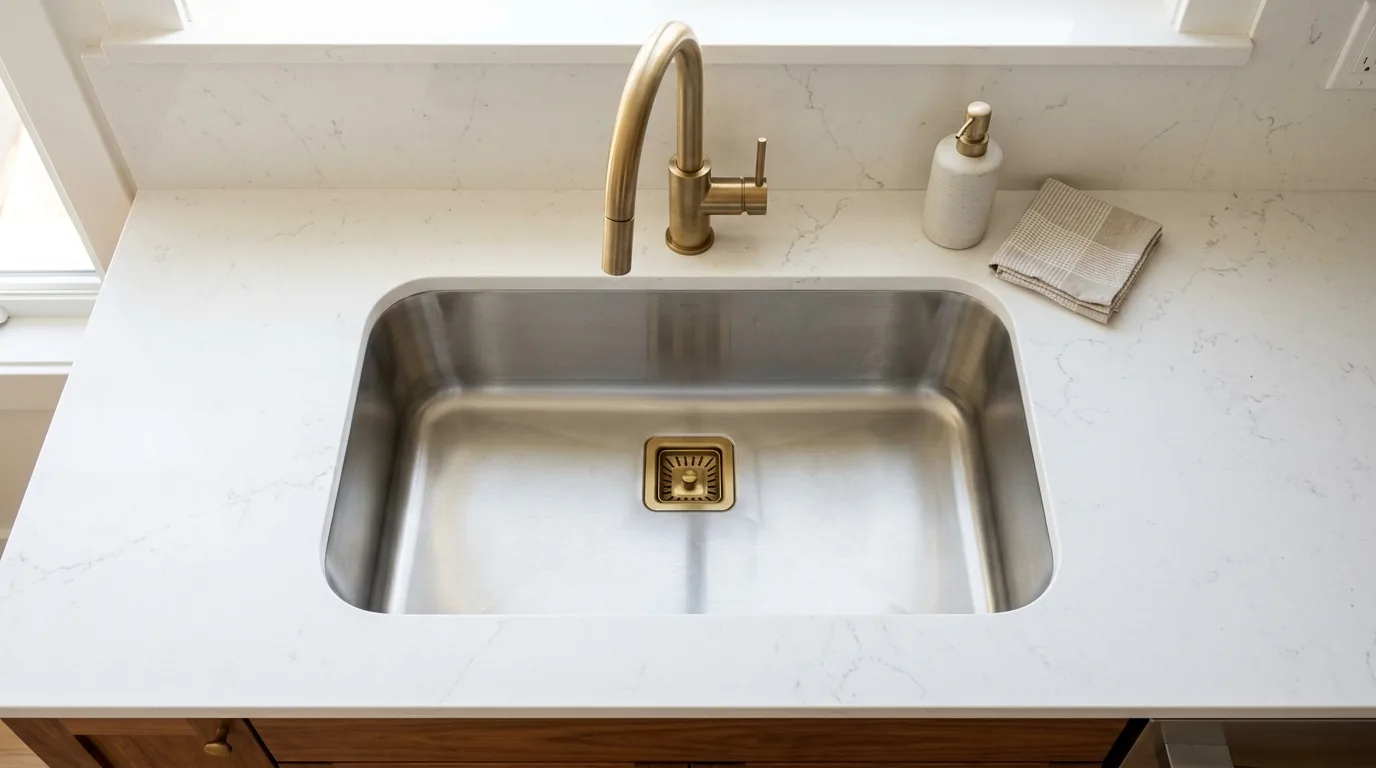
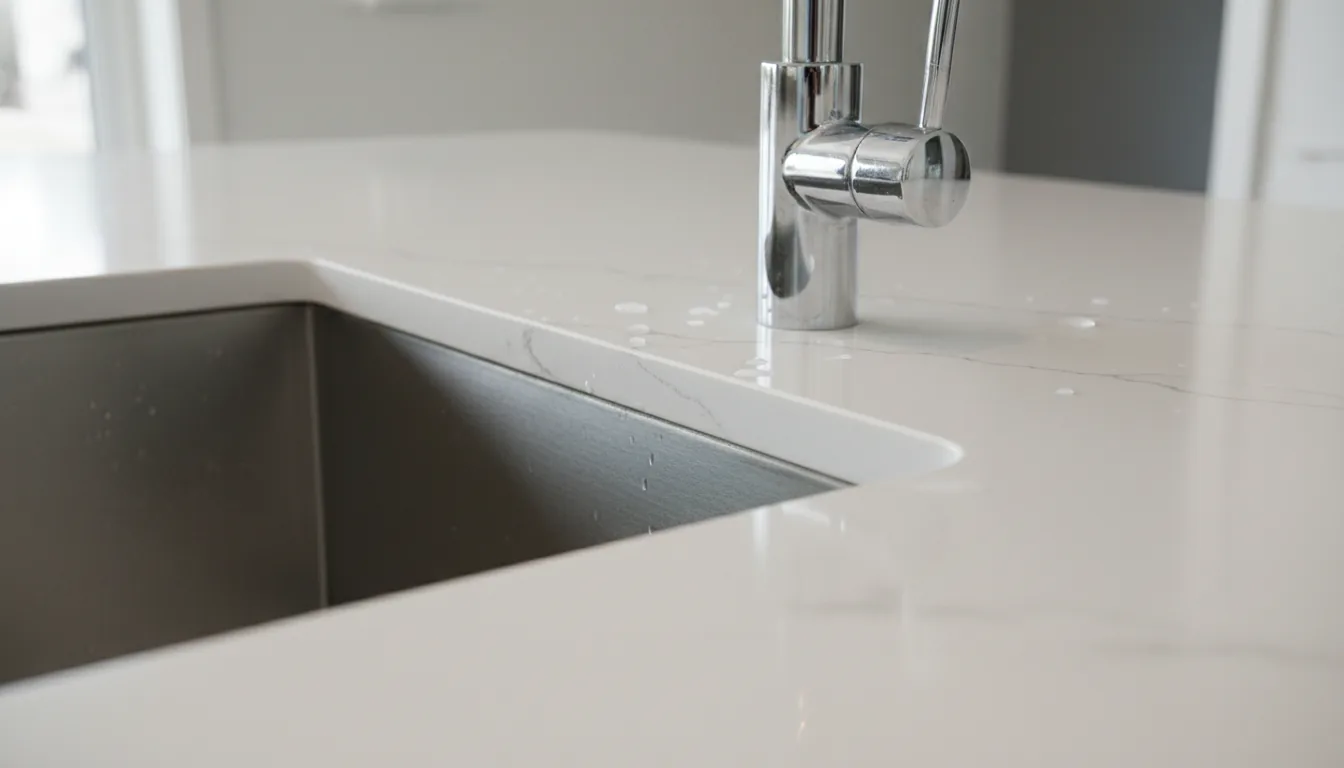
An undermount sink hangs below the countertop. The countertop surface extends over the edge of the sink bowl, so there’s no lip or rim sitting on top of the stone. When you wipe crumbs off the counter, they go straight into the sink.
A drop-in sink (sometimes called a top-mount or self-rimming sink) sits in a cutout with a metal rim that rests on top of the countertop. The rim seals against the counter with a bead of silicone. When you wipe the counter, crumbs catch on the rim and have to be picked up and moved.
That’s the whole difference, and it sounds small. In practice, twenty years of wiping a counter into a sink versus wiping around a rim adds up to a lot of annoyance.
Which One Fits Your Kitchen
The honest answer: if you’re installing quartz, granite, or quartzite countertops, go undermount. It’s what 95% of kitchens we build now use, it looks cleaner, and the extra cost is a rounding error on a remodel.
Drop-in sinks make sense in three situations:
- Laminate countertops. You can’t undermount into laminate — the particleboard substrate swells when exposed to water at a cut edge. Drop-in is the only option.
- Tile countertops. Grout lines don’t seal well against an undermount lip. Drop-in is easier to waterproof.
- Budget constraints and existing stone. If you’re replacing a sink without redoing the counters, and the original install was drop-in, swapping to undermount means re-cutting the stone. Usually not worth it for one sink.
Everyone else should undermount. The countertops we install — quartz, granite, quartzite, and marble — all handle undermount sinks without issue.
Depth, Bowls, and Material: The Other Three Decisions
Once the mount style is decided, three more choices drive how the sink actually works every day.
Depth
Sink depth is measured from the top rim to the bottom of the bowl. Standard kitchen sinks are 8 to 10 inches deep. Here’s the tradeoff:
- 7 to 8 inches: Short, rare now. Water splashes over the edge on a busy day. Avoid.
- 9 to 10 inches: The sweet spot. Deep enough to wash a sheet pan without splashing, shallow enough that short people don’t have to hunch.
- 11 to 12 inches: Deep. Looks impressive in photos. Causes back strain for anyone under 5’8” over the course of a long cooking session. Reduces usable storage in the cabinet below because the sink body eats into the cabinet space.
We recommend 9 or 10 inches for most kitchens. If you’re over 6 feet tall and cook constantly, 11 is fine. Don’t go past that unless you have a specific reason.
Bowls
Single-bowl sinks are winning. A big single bowl (30 to 36 inches wide) fits any sheet pan, cookie sheet, or roasting rack you own. You can wash a turkey pan in it.
Double-bowl sinks are still useful if you like to keep a stack of dirty dishes in one side while the other side stays free. They’re also the old standard, so if you’re used to washing on one side and rinsing on the other, stick with what works.
Low-divide (the center wall is half-height) is a middle ground that works for people who want two bowls but hate hitting a full-height divider when washing a big pan.
Material
The two practical choices for most kitchens are 16-gauge stainless steel and composite granite. Both last decades when taken care of.
- Stainless steel. 16-gauge is the standard for quality. 18-gauge (thinner) is what you find at big-box stores and sounds like a drum when water hits it. Stainless is cheaper, lighter, shows water spots, and any scratch can be polished out with a non-abrasive pad.
- Composite granite. Heavier, quieter (water hitting the bowl is muffled), hides water spots, and resists heat well. It costs roughly 2x stainless and is harder to repair if chipped.
What the Sink Means for Your Cabinets
The sink determines the size of your sink base cabinet. A 30-inch sink drops into a 33-inch sink base (you need room on each side for the cabinet frame). A 36-inch sink needs a 39-inch base. Farmhouse sinks require a custom sink base (more on that below).
This matters during the cabinet design phase because changing sink size late in the project means re-ordering a cabinet and delaying everything by 2 to 4 weeks. Decide on the sink (or at least the size) before the cabinets are ordered.
Undermount sinks also affect what can live underneath. Because the sink hangs down into the cabinet, the pull-out trash bin, filtered water system, or reverse osmosis tank all compete with the sink body for space. On a 33-inch sink base with a 10-inch deep sink, you lose about 30% of the usable cabinet storage below. Plan for it.
A Word on Farmhouse Sinks
Farmhouse (also called apron-front) sinks are the ones with the exposed front panel that sticks out past the cabinet face. They’re popular because they look distinctive and they’re usually deep and single-bowl.
Three things to know:
- They need a custom sink base cabinet sized for the specific farmhouse sink you’ve chosen. You can’t drop one into a standard sink base.
- Fireclay farmhouse sinks (the classic white ones) are heavy — often 80 to 120 pounds. The cabinet needs extra bracing, and two people to install.
- The countertop sits on top of the back flange of the sink, so the front edge of your counter actually ends before the apron starts. This affects how you wipe the counter and how water runs.
If you love the look, get it. But decide on the exact sink (model and dimensions) before cabinet ordering. The custom sink base has to be built to fit.
Mistakes We See Over and Over
The same five mistakes, on basically every remodel where the homeowner bought the sink without talking to anyone first:
- Sink is too big for the cabinet. Returning the sink or re-cutting the cabinet both cost real money. Size the sink to the cabinet, not the other way around.
- Buying a drop-in when the countertops are stone. Usually because the homeowner didn’t know undermount was an option. Always ask.
- 18-gauge stainless from a home improvement store. Sounds like a snare drum when water hits it. 16-gauge isn’t a luxury upgrade — it’s the baseline quality we install in every kitchen.
- Deep sinks with short people. If anyone in your household is under 5’6”, don’t go past 10 inches deep. Their back will hate you.
- Forgetting about the faucet. Your sink determines how much faucet clearance you have. Low-profile sinks need low-profile faucets. Pick both together.
Planning a Kitchen Project?
Free in-home consultation, 3D rendering, and a firm written quote — including sink and countertop. Palm Beach County only.
Se habla español
We respond within one business day · No spam, no obligation
Frequently Asked Questions
Is an undermount sink worth it over a drop-in?
For most kitchens with quartz, granite, or quartzite countertops, yes. Undermount sinks sit below the countertop, so you can sweep crumbs and water directly into the bowl and there’s no raised lip to clean around. The extra $200 to $400 in fabrication and install cost pays off every day in easier cleaning and a cleaner look.
Can you install an undermount sink in a laminate countertop?
No. Undermount sinks require a solid-surface countertop (quartz, granite, quartzite, marble, or solid composite) because they rely on the stone to hold the sink weight and provide a sealed rim. Laminate uses a particleboard substrate that can’t support an undermount sink and will swell if exposed to water at a cut edge.
What is the best sink depth for a kitchen?
9 to 10 inches is the sweet spot for most kitchens. Deep enough to wash a sheet pan without splashing, not so deep that you have to hunch over to reach the bottom. Deeper 12-inch sinks look impressive but cause back strain for anyone under 5’8” and reduce usable cabinet space below.
Do farmhouse sinks require special cabinets?
Yes. Farmhouse (apron-front) sinks need a custom sink base cabinet sized specifically for the sink. They can’t drop into a standard sink base because the front apron extends forward of the cabinet face. We size the sink base to your chosen farmhouse sink during cabinet design.
Stainless steel or composite granite kitchen sink?
Both are durable. Stainless steel is lighter, easier to repair (scratches can be buffed out), and cheaper. Composite granite is quieter, heat-resistant, and hides water spots better but is heavier and harder to patch if chipped. For most Palm Beach County kitchens we recommend 16-gauge stainless for a workhorse sink and composite for a statement look.
Related: Picking between cabinet types? RTA vs. Semi-Custom vs. Custom Cabinets →